KI kann nicht rechnen, oder doch?
OpenAI hat bekannt gegeben, dass eines seiner KI-Modelle ein berühmtes mathematisches Problem gelöst hat, das die Fachwelt rund 80 Jahre lang beschäftigte. Dazu ein spannender Artikel aus dem Wallstreetjournal: A Famous Math Problem Stumped Humans for 80 Years. AI Just Cracked It. - WSJ
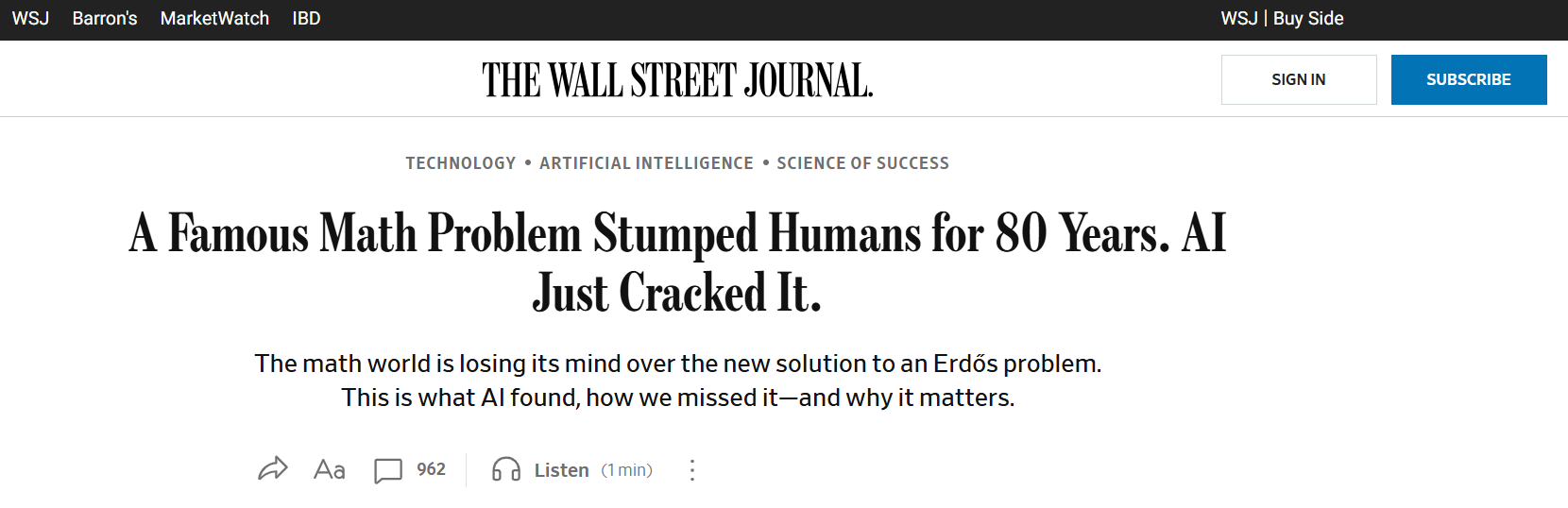
Das WSJ schreibt dazu: “‘If you are a mathematician,’ one of the world's leading mathematicians recently wrote, ‘you may want to make sure you are sitting down before reading further.’ And you'll definitely need to sit down if you're not a mathematician. Because a famous math problem that stumped humans for the better part of a century has finally been toppled - by AI. Not long ago, the most advanced AI models couldn't do basic math. By last year, they were performing at gold-medal levels at the International Mathematical Olympiad. Now, they are solving classic problems in combinatorial geometry using algebraic number theory. In no time at all, artificial intelligence has gone from stupid to frighteningly smart. But even mathematicians were astonished when OpenAI recently announced that one of its models resolved a puzzle known as the unit distance problem without the help of any humans scribbling a bunch of equations on chalkboards. It was fed a prompt and it spit out a proof. And everyone in math lost their minds.“
Der Fields-Medaillen-Träger Timothy Gowers äusserte sich besonders deutlich und sagte, er hätte die Arbeit ohne Zögern zur Publikation empfohlen, wenn sie von einem Menschen stammte. Kein früherer KI-generierter Beweis sei dem auch nur nahe gekommen.
Der Artikel nennt drei Gründe für den Erfolg der KI.
Erstens sei die Lösung stark kontraintuitiv, da die meisten Forscher versuchten, die Vermutung zu beweisen statt zu widerlegen. “Only by defying conventional wisdom and experimenting with seemingly improbable strategies did the model find an unexpected path forward.“
Zweitens verbinde die KI Wissen aus verschiedenen Gebieten. Sie synthetisiert während Menschen sich meist spezialisieren. “While mathematicians tend to focus on their specific areas of expertise, AI models use their vast knowledge to spot connections that we couldn't possibly see ourselves. In this case, that meant pulling from both algebraic number theory and discrete geometry, which have about as much in common as the marathon and pole vault.“
Drittens verfügt die KI über Ausdauer und gibt nicht auf, wo Menschen einen Ansatz frühzeitig verwerfen würden.
Die Gedankenkette des Modells umfasste über 75'000 Wörter, und Schätzungen zufolge dauerte die Lösung weniger als 32 Stunden und kostete rund USD 1'000 an Tokens.